Headmaster's Assembly : Monday 17th November 2025
An Assembly on hope, prompted by the thoughts of the BBC’s Chief International Correspondent, Lyse Doucet, who visited Stroud Book Festival last week.
Way back in September I gave a Monday morning assembly which looked at the idea of fear – I talked about the idea that fear is often a mile wide but just an inch deep. I’m sure many of you have experienced a degree of anxiety or fear about a number of things since then but I hope that you have reflected on what I said and combatted it by just going for it…and that the actual experience of whatever you were fearful of was, in reality, not that bad.
We are now in the much darker, colder midst of November and so today, I want to look at the idea of hope, but I want to tell it through an encounter with a well-known BBC correspondent I had recently here in Stroud.
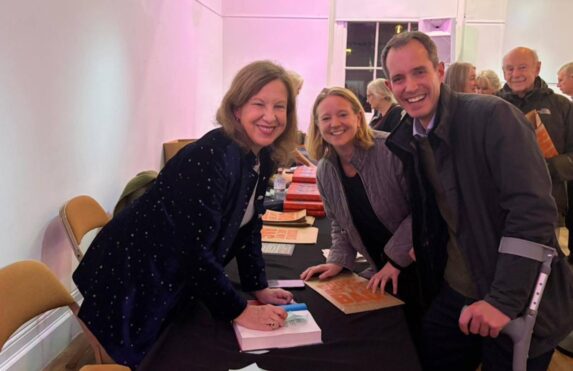
Two weekends ago, Mrs San Jose and I went out on Saturday night – yes, we actually left campus – and went to a talk as part of the Stroud Book Festival which has been running this month.
We listened to the BBC’s Chief International Correspondent, Lyse Doucet – you may recognise her voice from TV or radio which is a distinctive and notably mixed Canadian-French-British accent. She has been reporting from conflict zones for nearly 40 years and recently, she released her first book – “The Finest Hotel in Kabul” – which brings together a collection of stories from her numerous stays at the Inter Continental Hotel in Kabul, the capital of Afghanistan, over the last 30 years.
As an aside, she is a magical person – one of those individuals you meet who just exudes an aura of kindness and generosity. She gave everyone in the book signing queue the feeling that when she was speaking to them that they were the most important person in the world at that moment in time. A wonderful thing to be able to do. Normally authors simply sign their name inside the cover and move you on but she wrote full messages to every person and I wanted to share her message in the book we gave her to sign:
To dearest Rosie and Christian, thank you for your lovely smiles, for sharing this day, and this book. I hope it brings some joy.
That amazingly positive approach to life is something she has learned from years spent among the Afghan people who she says “believe that hope is the last to die”.
The Finest Hotel in Kabul is a book, like its author, full of wit and warmth, and human stories that tell of tragedy but also of love, resilience and hope. It also retells the story of Afghanistan over the last four decades since Lyse Doucet arrived there on Christmas Day in 1988 to report on the withdrawal of the occupying Soviet Army. She has not yet been able to return since the withdrawal of US, British and other NATO troops in 2021 when the Taliban returned to power and who now once more run the hotel.
Here are some of the characters in the book – Hazrat, Abida and Amanullah – whose stories she tells. All of their lives have been indelibly inked by the Taliban’s hand – often tragically.
And so we come to hope. We all have hope – at least I hope we do. There’s the everyday type of hope. For example, hoping that the day will be a good one, that we’ll feel better if we’re feeling under the weather, or that a match fixture or music performance will go well, or that a difficult conversation will pass without too much stress.
And then there is a different type of hope – hope that, as the 18th century poet Alexander Pope wrote….”springs eternal” – in reference to that fact that it is human nature to always find fresh cause for optimism.
In her book and in her talk last week, Lyse Doucet spoke about hope and how she has observed, across war zones and in places of extreme conflict and destitution, the quiet courage of people simply getting on with their lives, driven by the hope of a better future. They get up in the morning, make a warm drink, celebrate births, weddings, go shopping, and so on. If those people, so challenged by circumstance, can do this and find joy in the everyday, what right do we have, with our safety, security and modern comforts and freedoms, not to hope for a better future?
I will at this point, just caution that too much focus on hope – hope that things will turn out alright, or get better, can mean you fail to focus on the present and thereafter continue to chase something that may not materialise. Those people who are in the direst of situations cling onto hope for a better future but they also seek joy in the present wherever they can in those aforementioned weddings, birthdays, and celebrations.
Lastly, as I often do, I turn to Shakespeare for his thoughts on hope. In his play “Measure for Measure”, we hear Vincentio, the Duke of Vienna, say “the miserable have no other medicine…But only hope”.
For those of us who have nowhere to turn, there is always hope as the cure to all ills – something good to remember when all seems lost.