Headmaster's Assembly : Monday 1st December 2025
In the wake of the Hong Kong apartment fires, how should we feel when witnessing such scenes of human tragedy unfold on our screens?
Last week, for some unknown reason, I switched on the TV and found myself accidentally watching the tail end of an episode of “I’m a Celebrity Get me Out of Here”. I didn’t recognise any of the celebrities, but I was fascinated by the live bushtucker trial that was about to take place. In pairs, the celebs faced off, each having to choose a disgusting concoction for their rival to drink as quickly as possible in a race off against each other. The blended drinks on offer varied from that of sheep’s brain, fermented fish eggs, to camel brain, pig snout and goats’ testicles. Several of the celebs threw up live on camera.
Later that evening at bedtime, my 9-year-old son, who was watching it with me, said “I can’t stop thinking about what I saw on the TV earlier”. I was completely taken aback by how affected he was by what he had seen – clearly a massive parenting fail – and he couldn’t then get to sleep and was still queasy the next day. I haven’t shared this story with my wife yet, so let’s just keep this between us.
One of my greatest fears for my own children, and the current generation in the wider sense, is how often-unintended exposure to material – be that explicit, pornographic, misogynistic, violent or simply horrifying – via television, social media, reels, etc. can inadvertently create life lasting anxiety and harm. One cannot unsee what you have seen. My son Nicholas will get over the bushtucker trial, but it was a lesson for me to be more aware of what I allow him to see on television whilst he is still so young. And that lesson extends to you too – please be careful what you engage with online.
Earlier this term, I spoke about the brutal assassination of Charlie Kirk who was shot through the neck at a political rally in the US. Within seconds, raw footage of the moment of the killing was all over social media and many millions of people, of all ages, will have seen the film. Such images are horrific and no child should be exposed to scenes like this…but they were and are, multiple times each day…one only has to spend a few minutes on Instagram to come across clips of people being mutilated in horrific accidents caught on camera. In my view, this is one reason why age limits for social media should be enforced.
Often “seeing” something horrific on a screen that involves death/destruction/suffering happens so incredibly out of context. Whilst in some ways we have become used to, almost immune, to scenes of human tragedy and suffering on our screens – bombings, gunfights and death in Gaza and the Ukraine have been screened almost nightly on the news for the last few years – there is something in all of us which makes this sit uneasily.
Last week, I wrote to the families of our pupils from Hong Kong on behalf of the Wycliffe community and expressed our sympathies for the tragic apartment block fires that have so far claimed nearly 150 lives and made many others homeless. This was important to show empathy with the situation.
About 8 years ago, some of you may remember that London suffered a similar tragedy when the Grenfell Tower block in Kensington caught fire and burned for nearly 60 hours, claiming 70 lives. The then Prime Minister Theresa May was heavily criticised for not visiting and speaking to residents the day after the fire…many said she failed to show humanity and empathy with their plight.
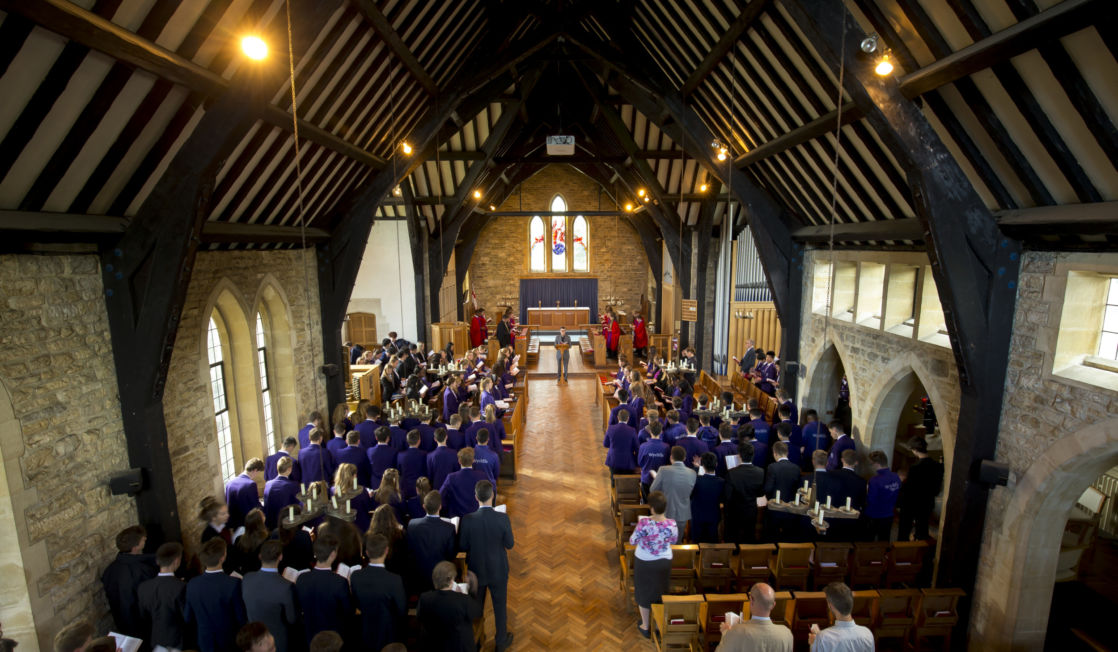
And then we have perhaps the most awful sequence of events ever caught live on camera: the terrorist attack on the World Trade Centre and the twin towers’ subsequent collapse on 9/11. Although none of you were yet born, I imagine all of the adults in this Chapel today can vividly recall that event – I distinctly remember not knowing how to feel – yet instinctively feeling this huge sense of unease and horror at the same time.
So here we have human tragedy…in the age of mass media – horrific scenes of carnage, destruction and death played out in front of us. But we are detached. I don’t think I am the only one who asks myself the question when I see something awful on screen: how should I feel when I watch this?
There is no easy or right answer.
When I sat down to write this assembly I wanted to bring things together under the umbrella of empathy and ultimately to pose the question: how do we empathise with others in the age of mass media when we are detached and largely desensitised to things?
And the answer, I think, is simply this. Be human. I have lost count of the number of times people being interviewed on TV who have trotted out the same line about how their thoughts are with the victims and the families of the victims…it almost feels fake and I now immediately switch off.
It’s ok to be unsure. It’s ok to not know quite how to respond sometimes. But, as I said in assembly a couple of weeks ago, we all have a responsibility to be interested in events and things where fellow human beings are being harmed – taking an interest, and talking about it, is a key part of enabling empathy.
And it ultimately comes back to our values – what we hold as important to who we are as a person or as a community, will dictate how we feel and respond to events.
There are fortunately very few of us who have been exposed to violence, war, conflict and harm in real life…but we are foolish to live in and of a generation where war is reduced to a computer game simulation or a minor news item for us.